
Chattooga Quarterly
Summer 2005
Endangered Plants in the Watershed
Carol Greenberger
The small whorled pogonia was moved from endangered status to threatened in 1994.
"Nothing is more priceless and more worthy of preservation than the rich array of animal life with which our country has been blessed. It is a many-faceted treasure, of value to scholars, scientists, and nature lovers alike, and it forms a vital part of the heritage we all share as Americans." These words of President Richard Nixon heralded the signing of the Endangered Species Act (ESA) in 1973, designed to protect the diversity of animals and plants throughout our nation. With an almost unanimous vote from Congress, the ESA was a rewrite of the 1966 Endangered Species Preservation Act. The original act, inspired by the plight of the whooping crane, authorized the listing of endangered domestic fish and wildlife, established a budget for the Fish & Wildlife Service to purchase habitat for listed species, and directed federal land agencies to preserve endangered species habitat. This law, as well as one passed in 1969, while an important beginning gave little meaningful protection to listed species. The Endangered Species Act went many steps further.
The 1973 ESA distinguished threatened from endangered species, added plants and invertebrates, authorized unlimited funds for species protection, and made it illegal to harm or kill a listed species. The act encouraged states to develop and maintain conservation programs for federally listed species, and established a system of incentives and financial assistance. Recovery plans were required for each listed species, describing the steps needed to restore the species to health. Designation of critical habitat, geographic areas essential to the conservation of listed species, was an important aid to the legislation’s ability to effect positive change. The objective of the act is to provide a means for conserving the ecosystems that threatened and endangered species rely on, above virtually all other considerations. This was a change from the earlier language that called for protection "where practicable." The ultimate goal of the Endangered Species Act is to make itself obsolete by recovering species to the point that they no longer need protection.
The Endangered Species Act has been amended eight times since its passage. These changes included: allowing a cabinet-level committee to exempt actions that would jeopardize a listed species; requiring the determination of the status a species to be made solely on the basis of biological information, without consideration of possible economic effects; monitoring of candidate and recovered species; public notice and review of recovery plans; and reports of all identifiable expenditures on a species by species basis.
The ESA is administered by the U.S. Fish & Wildlife Service and the National Oceanic and Atmospheric Administration. According to the U.S. Fish & Wildlife Service there are currently 1264 listed species, 988 of these are endangered and 276 are threatened. An endangered species is one that is in danger of extinction throughout all or a significant portion of its range. A threatened species is one that is likely to become endangered in the foreseeable future. Species may be listed due to destruction of habitat; overuse for commercial, scientific or educational purposes; disease or predation; inadequacy of existing regulatory mechanisms; or other natural or man-made factors affecting its continued existence. Anyone can petition the Fish & Wildlife Service to consider a species for listing, reclassification or de-listing. The Service and other agencies also conduct surveys and field studies to examine the health of plant and animal species.
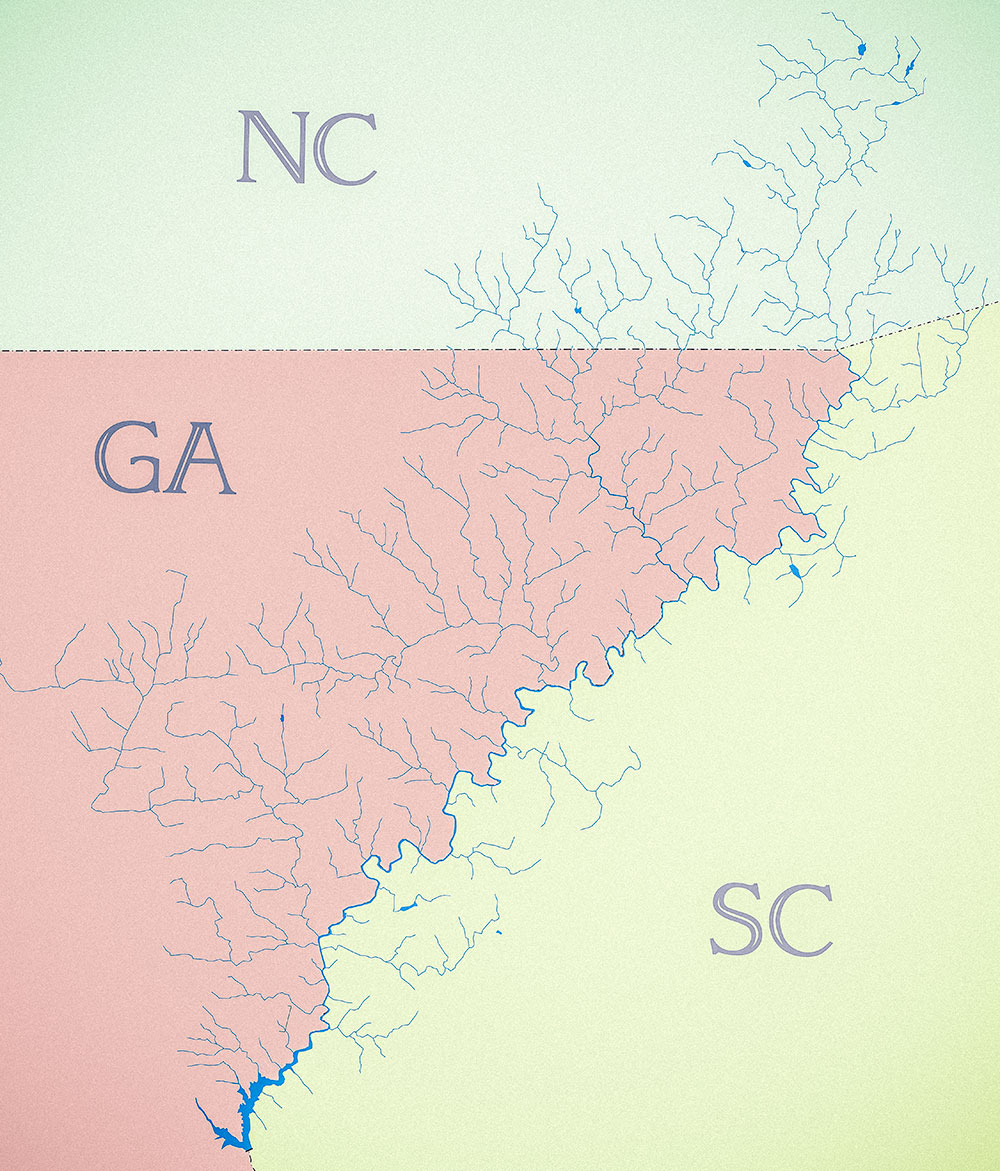
Plants account for 599 of the listed endangered species and 147 of the threatened species. South Carolina currently has 20 listed plants, North Carolina 27, and Georgia 23. There are 50 total different plant species listed in the three states. About 12 of these listed plants can be found in the Chattooga watershed. Many of these plants are only found in a few sites in the watershed, and each of these separate groups of the species is called a population or colony. The decline of most of the plants that are listed as endangered or threatened has been the result of the encroachment of civilization into what were once forests or prairies.
The smooth coneflower, Echinacea laevigata, is one of the endangered plants that can still be found in the Chattooga watershed. Historically, the smooth coneflower grew in Pennsylvania, Virginia, Maryland, North & South Carolina, Georgia, and Arkansas. It survives today in four states, including South Carolina and Georgia. Over two-thirds of the historic populations have been destroyed, and the plant was listed as endangered in 1992. This member of the Aster family can be found in the open woods, clear cuts, roadsides, cedar barrens, and dry limestone bluffs. While the blooms of the smooth coneflower look that of its relative, the purple coneflower that we are familiar with, it can be distinguished from other species of Echinacea by its smooth leaves, in contrast to the usual sandpapery textured leaves. The plant thrives in abundant sunlight and little competition in the herbaceous layer. The species requires bare soil for seed germination. Careful clearing, fire or some other type of suitable disturbance is essential to the survival of the smooth coneflower. Formerly the plant probably occurred in prairie-like habitats or post oak savannas maintained by fires set by Native Americans or caused by lightning. Loss of open habitat due to the growth of cities and suburbs, highway right-of-way maintenance, collection, fire suppression and possible predation by insects have all played a part in the decline of the species.
In South Carolina’s Sumter National Forest, the Forest Service began the first experimental management for this species using fire in 1992. After clearing woody vegetation from a site and then conducting a prescribed burn, the smooth coneflower population quadrupled. In Georgia’s Chattahoochee National Forest, the Forest Service is monitoring the populations and mowing on a timed schedule to benefit the plant. Prescribed burning was also conducted on that site.
The recovery plan calls for protective management of the known populations, surveying to find suitable habitat for additional populations, and research on the biology of the species and its natural ecosystem. The plant will move from endangered to threatened when twelve geographically distinct, self-sustaining populations are protected in at least two counties each in Virginia, North Carolina, South Carolina, and one in Georgia. The populations must maintain a stable or increasing level for five years, and at least nine of the populations must be in natural habitats in permanent conservation ownership and management. Delisting will be considered when there are fifteen populations that have been stable or increasing for ten years.
Two endangered species of trillium can be found in the Chattooga watershed, Trillium persistens and Trillium reliquum. Persistent trillium was listed as endangered in 1978. The species is very restricted in distribution and today exists in four populations that are within 5.3 miles of each other. This species of Trillium blooms earlier than most others, from mid-March to mid-April. It produces a single, white, three-petaled flower on an erect stalk. The petals of the flower turn purple as the bloom ages.
Persistent trillium generally grows in deciduous or mixed hemlock-pine-deciduous woods on steep slopes, gorges or ravines, under or near Rhododendron maiximum or R. minus. They root in loose loam and well-decomposed litter. Soil moisture is probably the most influential factor in the distribution of the species at each site. The limited range and population size of persistent trillium makes it vulnerable to anything that reduces its habitat such as clear cutting, logging and power line construction. It is also likely that the damming of the Tugaloo and Tallulah Rivers to form lakes destroyed some colonies of persistent trillium. Over-collecting because of the plant’s rarity also threatens its existence.
Most of the plants in both South Carolina and Georgia are located on land belonging to Georgia Power Company. The company has entered into agreements with both states to protect the persistent trillium found on their land and have protected the habitats from timber cutting and development. Callaway Gardens is developing propagation techniques for the species, and seeds have been placed in the US Forest Service’s National Tree Seed Laboratory for germination studies and long term storage. The recovery plan for Trillium persistens seeks to provide permanent protection for the habitat of at least 75 percent of the known plants, search for additional populations, develop and implement appropriate management guidelines, make available commercial sources for the species, provide long term seed storage, enforce the laws that protect the species and increase public awareness.
The small-whorled pogonia, Isotria medeoloides, is listed as threatened in Georgia, North Carolina and South Carolina. Originally deemed endangered in 1982, the species was reclassified as threatened in 1994. This member of the orchid family has a single or pair of yellowish-green flowers with a greenish-white lip. Its five or six leaves grow in a circular arrangement, a false whorl. Although sparse in population, the species has a wide range extending from Maine to Georgia. The Nantahala, Sumter and Chattahoochee-Oconee National Forests all have colonies of the small whorled pogonia. The sites generally share a few characteristics: sparse to moderate ground cover, a relatively open understory canopy, the presence of decaying vegetation, and proximity to logging roads or streams that create long, persisting breaks in the forest canopy. Other than these similarities in habitat, the species can be found in widely different settings.
While over collecting was originally identified as one of the two main threats to the small whorled pogania, habitat destruction has become the primary problem. Residential and commercial development is the primary factor in destruction of the species habitat, as well as the construction of roads, power lines and sewer mains that accompany growth. In some cases though, education and public awareness have been successful in protecting populations of the small whorled pogonia. In a subdivision near Williamsburg, Virginia a road and sewer main were rerouted to avoid destruction of a colony. In Connecticut, a trail through a state forest was rerouted. Recovery efforts also have aided by research.
The Endangered Species Act has helped us as a nation make great strides in species conservation. Unfortunately the law’s original intent has been diluted by politics and lawsuits. Draft legislation, soon to be introduced to Congress, has been prepared by the Republican staff of the House Resources Committee that would greatly further weaken the ESA. In order to protect the wonderful and fascinating diversity of species our country is endowed with, the focus must return to conservation over special interests. We can each do our part by being aware of the endangered and threatened species in our watershed, and trying above all, to do no harm.