
Chattooga Quarterly
Summer 2005
Interstate 3
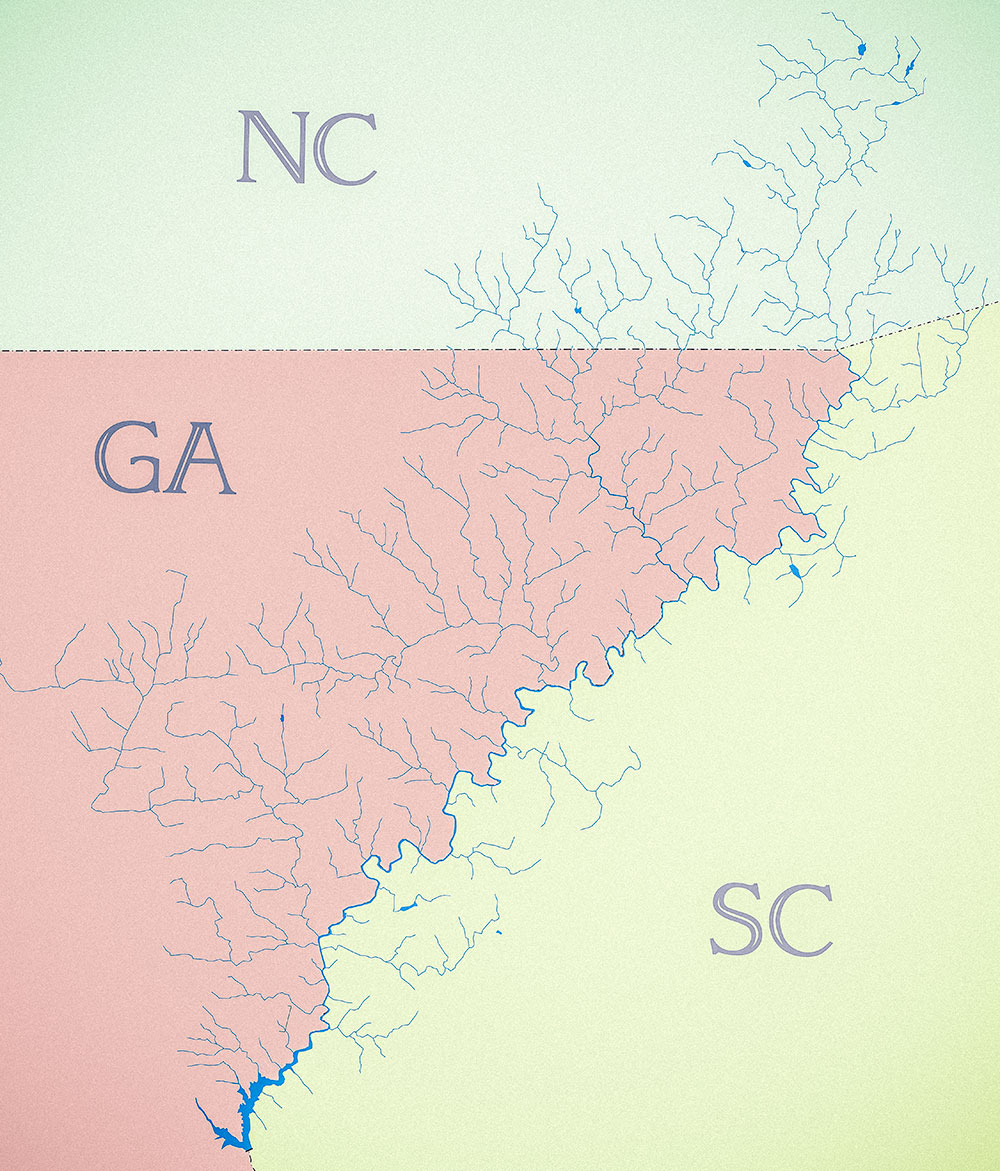
Buzz WilliamsAn interstate highway wider than three football fields is on the fast track for the north Georgia mountains. The initial route, outlined in federal legislation authorizing a "study" of feasible routes and cost, would connect the port of Savannah, Georgia, to Knoxville, Tennessee, and pass through the mountains near Helen, Georgia. However, the proposed route through the north Georgia mountains for Interstate 3, as it has been named, could change depending on the outcome of the feasibility study. Strong opposition from White and Towns Counties, which lie in the first proposed route, is already causing proponents of the road to talk about other options. According to Georgia State Representative Charles Jenkins, whose electorate includes residents of the northeast Georgia mountains, the route could shift to Highway 441 through Rabun County, where current road widening is already underway. Jenkins opposes the highway and claims to be in contact with the Georgia federal delegation that proposed the legislation for the feasibility study. He said in a recent public meeting in Rabun County, "They say this thing is a done deal," and later, "all I’m hearing is Highway 441." That would put an Interstate Highway in the Chattooga River watershed along Stekoa Creek—already the most polluted tributary to the National Wild & Scenic Chattooga River. The Chattooga Conservancy is mobilizing to stop I-3.
Here are the facts: On July 22, 2004, Congressman Max Burns (R-GA) introduced legislation in the U.S. House of Representatives conceptualizing two new interstate highways. One, called I-3, would link the port of Savannah, Georgia, and the Midwest through Knoxville, Tennessee, going north of Atlanta through the north Georgia mountains. The other, I-14, would intersect I-3 at Augusta, Georgia, taking off south of Atlanta to Montgomery, Alabama, and on to Natchez, Mississippi. Georgia Congressman Charlie Norwood (R-GA) co-sponsored the legislation. A similar bill was then introduced into the U.S. Senate by Georgia Republican Senators Saxby Chambliss and Zell Miller. Opposition that was beginning to build subsided somewhat when Burns was defeated in last November’s elections, but concerns remained about future efforts to renew the push for the interstate in the 109th Congress.
In January of 2005, Congressman Norwood introduced House Bill 301 requiring the U.S. Department of Transportation (US DOT) to study the same interstate system as proposed earlier by Burns. Reasons for constructing I-3 and I-14 listed in the bill were threefold: 1) to provide a linkage between military facilities to provide better national security; 2) for economic benefits, more expeditious transportation and safety; and, 3) to honor the U.S. Army 3rd Division that served as the "tip of the spear" during the latest Iraq war. The bill required the U.S. DOT to report back to congress on the feasibility and cost of construction no later than December 31, 2005.
The efforts of the Georgia delegation to pass legislation authorizing the feasibility study bogged down "in committee" as had the earlier effort by Burns, prompting a new strategy. On March 10th, legislation for the study of I-3 and I-14 passed the U.S. House of Representatives as a part of HR3, the Transportation Equity Act, by the margin of 419 to 7. Cost of the study was earmarked at $400,000. Soon afterwards, Senators Saxby Chambliss and Johnny Isakson (R-GA) introduced almost identical legislation in the U.S. Senate as SB 459.
On April 26th, Congressman Norwood sent out a legislative update with an outline of the I-3 proposal and a map of the general route as proposed through Helen and Hiawassee. Norwood was quoted as saying, "It is critical that we begin these projects as quickly as possible, while many sections of existing highways can be incorporated into the routes of both new interstates. Every day of delay runs the risk of development cropping up that will require a great deal more money to accommodate."
On May 17th, the U.S. Senate passed the Transportation Bill containing provisions to fund the feasibility study for the two interstates. Matt Sawhill, Senator Chambliss’s northeast Georgia regional representative, was quoted as saying that the project has "overwhelming statewide support." Sawhill pointed to "studies" that show that 80% of jobs are located within five miles of an interstate.
Indeed, many do support the idea of bringing an interstate through the Deep South. Among those who support the project are U.S. House Representative Lynn Westmorland (R-GA) who sits on the House Transportation Committee, Senate Majority Leader Bill Frist, (R- TN), former Majority Leader Trent Lott, (R-MS), Georgia State Development Commissioner Craig Lesser, Georgia Transportation Commissioner Harold Linnenkohl, Robert Morris representing the Georgia Ports Authority and Bill Hubbard, President of the Savannah Area Chamber of Commerce. Big industry also supports both interstate projects including Home Depot, Georgia Pacific, the Georgia Mining Association, the Knoxville based Goody’s Family Clothing Inc., and Sea Ray Boats Inc.
The Georgia State Legislature made their feelings clear in the 2006 budget that includes $100,000 to establish the Interstate Highway Development Association for the purpose of promoting both interstate projects. This position is clearly motivated by the argument that both I-3 and I-14 would ease traffic problems in and around Atlanta by rerouting truck traffic through the countryside.
On a local level, support tapers off at around Dawson County, where opinions vary. Clarkesville Mayor Sam Tolbert takes a noncommittal position; "I don’t think it would hurt, but I don’t think it would help us," Tolbert told news reporters. Further north, however opposition is strong. In a town hall meeting in Hiawassee on May 24th, 650 people showed up to voice an overwhelming opposition to the project. Then on June 7th in Rabun County, 178 citizens applauded and gave a standing ovation to the Rabun County Commissioner’s unanimous opposition to the proposed interstate through the north Georgia mountains.
Opponents of I-3 are uniting forces across the Blue Ridge, not only in North Georgia but in both South and North Carolina. Chapters of an interstate opposition group called Stop I-3 have already held several organizational meetings with a common goal to stand together to stop the project before it gets any further. But backers of the interstate highway project are pushing hard with a target date for the President to sign legislation by August, and to begin construction within five years. Again according to State Congressman Jenkins, the Georgia delegation doesn’t really need the relatively few votes in north Georgia to get elected. They see themselves as serving the greater good of traffic-stressed Atlanta and regional development. Norwood’s Communications Director John Stone puts it this way, "Right now, there’s only a tiny group opposed," he said. "These folks have built retirement homes up there and want to lock themselves in as far as development."
The task of stopping an interstate highway with such political clout and regional support will be a daunting task. Opposition forces must now expand a local argument to a national level with clear reasoning that appeals to the grassroots. Putting together a coalition is a must, with strategies for media, legal support, and civil disobedient, nonviolent protest. The key, of course, must be to convince people outside the region that there are alternatives to the reasons the pro-interstate side has given for sacrificing the pristine environment of the mountains for questionable economic development.
There are flaws in the argument that the region needs I-3 to link Savannah to the Midwest. The current 450-mile route from Knoxville to Savannah would only be shortened by 15 miles. The cost of building an interstate highway is about 25 million dollars per mile, with a total cost for I-3 in the neighborhood of 50 billion dollars. This staggering sum could better be spent on mass transit that would solve Atlanta’s traffic woes while going a long way to address serious air quality problems from Atlanta to the Great Smoky Mountains. According to D. J. Gerken of the Southern Environmental Law Center in addressing Atlanta’s traffic problems, "Peak hour traffic is the problem, and that’s locals."
The argument that the interstate is necessary for homeland security seems aimed at tapping into patriotic sympathies, without much fact. The highway system that currently exists seems to be more than adequate to move troops and supplies. Both Fort Stewart in Hinesville, Georgia, home of the 3rd Infantry Division for which I-3 is named, and Hunter Army Airfield are located just outside Savannah, and are already served by a four-lane highway. The distance from Savannah to Fort Gordon and the Veterans Administration Hospital in Augusta is only about 140 miles. Necessary improvements to the roads between these military facilities are more than sufficient for national security without even coming near the mountains, where no major military facilities exist. One would only have to ask troops in Iraq or Afghanistan if they would rather see an interstate in the north Georgia mountains, or have 50 billion dollars spent on body and vehicle armor, to get a good argument against I-3.
Then there is the safety argument. Proponents of I-3 do not deny that one possible use of I-3 would be to move tritium and MOX fuel between the Savannah River nuclear facility to other nuclear power plants and Oak Ridge, Tennessee, for processing. Moving the most dangerous poison known to humanity through steep, rugged terrain where snow, ice, and fog are common would be nothing short of extremely unwise.
The economic argument for I-3 is equally flawed. Suffice it to say that the real question is: what kind of economic development? Interstates bring sprawl in the form of convenience stores, fast food joints, warehouses, noise, congestion and pollution. The mountain region economy is fueled by nature based tourism, family farms, and second home development. In fact, the kind of development brought by an interstate would literally kill the goose that lays the golden egg.
Environmental destruction as a result of interstate highway construction would be staggering if I-3 were built through the Blue Ridge Mountains. Wildlife corridors would be severed, streams would be choked with silt, and scenery would be destroyed. Air quality would be even worse in an area already on the EPA’s non-attainment list. In short, a pristine environment that is the key to good health and a good economy would be sacrificed for a few big corporations that want to move more goods from China through the Port of Savannah to big box stores across to the Midwest.
The fight to stop I-3 will be daunting. We have outlined here the case for and against I-3. You make the choice. Joining the fight to stop I-3 may be one of the most important decisions that people who care about the pristine environment of our Blue Ridge Mountains will ever have to make. Please get involved now. Which side will you take? In coming months, we will keep you posted on actions and events to stop I-3. Call and write your representative in congress and demand this foolish project be withdrawn before it starts.